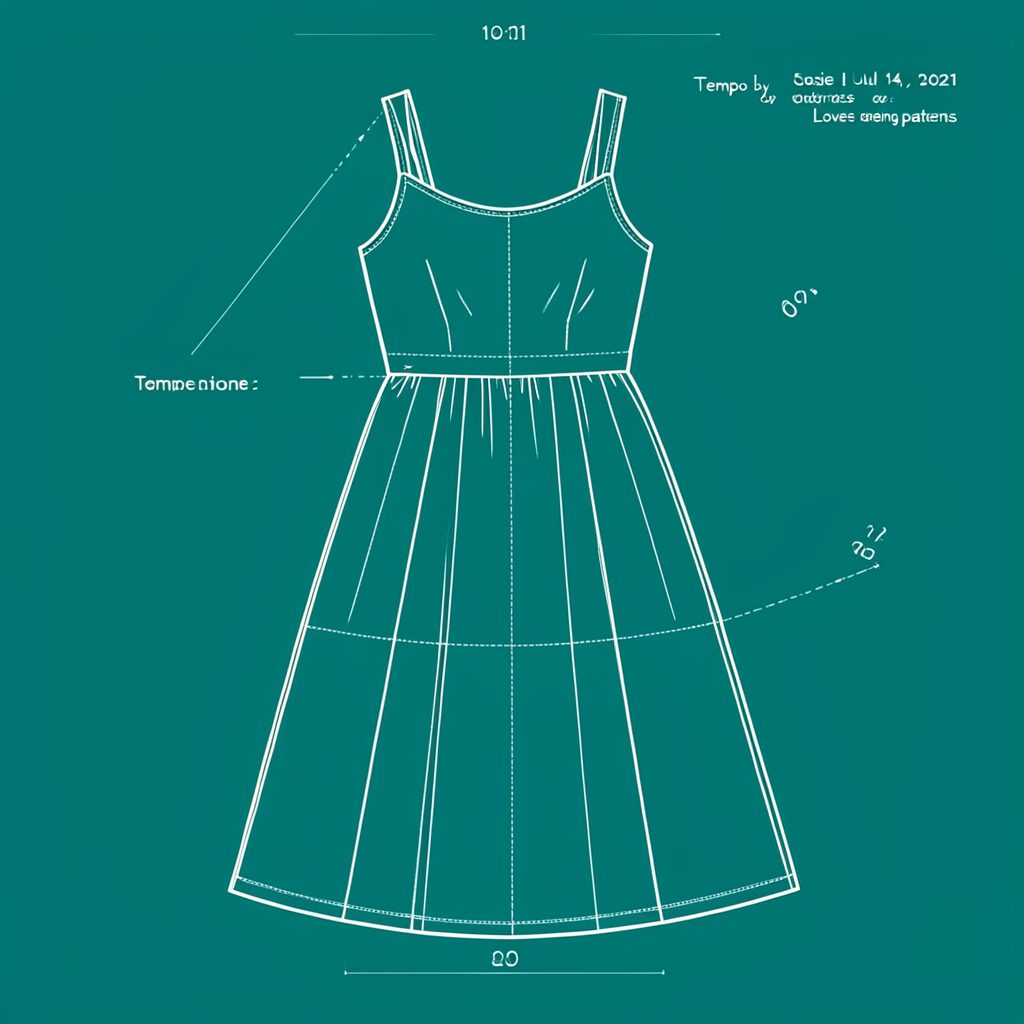
Shortening the Love Notions Cadence Dress for a Tunic
The Love Notions Cadence Dress has the ease and movement of a longer garment, but its neckline and upper-body details can look beautifully balanced once the hem sits at tunic length. Shortening it is more than trimming off a few centimetres: the new proportion, fabric drape and way it sits over trousers or leggings all need checking before the paper pattern is cut.
I work from the fit of the dress on the body, then transfer that length to a paper pattern. This approach suits the Cadence because its flowing shape can disguise small measurement differences, yet a badly shortened version can look either too dress-like or oddly abbreviated. The aim is a wearable blouse-length layer, not simply the shortest possible skirt.
Why the Cadence works as a tunic
The Cadence was drafted as a dress, so its lower edge works with the volume and vertical rhythm of the whole design. A tunic keeps much of that generosity but changes where the eye stops. The existing bodice should therefore remain intact, while the alteration happens at the lower pattern edge or at a carefully chosen waist pivot.
Start by asking what the garment must do. A loose woven tunic for office wear can sit over slim trousers, while a softer version can work over leggings or jeans. Keeping the original neckline and sleeve shape preserves the designer’s intent, and the repeated measurements I store in my sewing notes make it easier to compare each fitting without relying on memory.
Setting the finished length
Put the dress on with the base layer and footwear you expect to wear, then pin the hem at the side seam, centre front and centre back. Do not force one level across every point. Measure from the high point of the shoulder to each pin and record the smallest comfortable length, allowing for posture, movement and the rise of your trousers.
Stand, sit and walk before removing the pins. A hem that feels right while standing can rise when you sit, particularly with a gathered waist or full lower section. Check whether the shortened shape needs a small side-seam adjustment to prevent the lower body from appearing too wide, but retain enough ease for the tunic to drape.
Australian pattern sizing may still be given in inches, so convert the final measurement before marking paper. A useful comparison is 5 cm to 2 in, 10 cm to 4 in and 20 cm to 8 in. Because Australia’s seasons run opposite those in Yorkshire, think about the months when the garment will be worn rather than following a northern-hemisphere sewing calendar.
Comparing the main shortening methods
Four approaches suit different amounts of shortening and different pattern shapes. The right choice depends on whether you want a temporary fitting adjustment, a straight replacement hem or a more considered re-draft that also controls the width of the lower body.
| Approach | Best suited to | Main advantage | Watch-out |
|---|---|---|---|
| Fold-up tuck | Small adjustments | Fast fit check | Can create bulk and is not the finished hem |
| Replacement hem line | Straight styles and larger reductions | Simple and predictable | Side seams and seam allowance must be corrected |
| Waist pivot | A pronounced change in proportion | Keeps upper details intact | Requires the bodice fit to be accurate |
| Lower-section re-draft | Shaped hems or excess fullness | Controls length and width | Takes more measuring and drawing |
For most alterations, I would begin with a calico toile and a replacement hem line. Mark the desired finished edge on the pattern, add the correct seam allowance outside it, and redraw any affected side seam. Cutting straight across the paper at the new hem without accounting for that allowance creates a garment that is difficult to turn or hem.
If the pattern is continuous through the waist, overlap it at a tested waist point to take up the required length, then true the side edge back to its original angle. If it has a separate lower section, shorten that piece and keep the waist seam unchanged. Check grain marks after either route so the shortened silhouette still hangs naturally.
Preparing the pattern and fabric
Work on copies and leave the original PDF untouched. Trace the side seam, hem and grainline, then move the alteration rather than redrawing everything from memory. If the original hem allowance is generous, it may be possible to repurpose some of it; otherwise, remove the old allowance and build a new one below the revised finished hem.
Prepare the cloth before cutting. Wash or steam-test it for shrinkage, press according to its fibre and check for a nap or one-way print. A woven cotton or viscose will often behave differently from the sample fabric, while a knit may grow after cutting, so make any major length decision after the fabric has settled. Use pins rather than stretching the pattern when cutting bias edges.
A clear checklist before cutting
Before committing to the final cloth, use the dress itself or a calico version to settle the proportions. Real wear testing matters in busy family homes, and I also keep a few practical ideas from World Wide Mom in mind when judging comfort and movement.
Fit and length
- Try the intended base layer and usual shoes.
- Pin the side seam, centre front and centre back separately.
- Record the shoulder-to-hem length in centimetres.
- Recheck after sitting, walking and standing for a while.
Checking the pattern and cloth
- Wash or steam-test the fabric before cutting.
- Mark the grain, fold and existing hem allowance.
- Match the fabric type to the pattern instructions.
- Make a cheap calico toile for a large change.
Once those checks agree, write the new finished length on the pattern and beside the toile measurements. Use one reference point, such as the high shoulder seam, so an error is not repeated on the bodice and lower sections. The paper should describe the garment you intend to sew, not merely the shape you hope it will take after assembly.
Styling and sewing for Australian life
A tunic is particularly useful in Australian wardrobes because it handles layering without looking heavy. In humid Sydney and Brisbane, a breathable cotton or linen blend works over leggings or shorts; in Melbourne, a mid-weight fabric can move between air-conditioned offices, school runs and cooler evenings; in Perth and Adelaide, considered neckline coverage remains practical in strong sun.
Fabric shopping can happen at Spotlight, independent neighbourhood haberdasheries, remnant bins and online Australian stores. Compare metres rather than relying on a dramatic sale, and check fibre content and shrinkage before buying. For a first alteration, remnants or inexpensive calico are sensible; for daily wear, a stable woven with gentle drape usually handles the shortened shape more predictably.
If the remake is sold, Australian consumer law and applicable state fair-trading rules require fibre, care and origin claims to be accurate. The pattern’s copyright is also relevant under the Copyright Act 1968 (Cth): personal alteration under the licence is different from publishing an edited pattern file. I explain commercial relationships and affiliate arrangements in my disclosure policy, while handmade labels should still identify the maker and care requirements honestly.
Finishing and evaluating the remake
Finish the new hem according to the cloth: use a narrow double hem on firm wovens, a rolled or bias-bound edge on softer fabric, and a stable stretch finish where appropriate. Overlock or clean the raw edges before the final press, then let the garment hang for a day. This settling time often reveals a hem that looked level while pinned.
Try the tunic in several base layers and check arm movement, neckline clearance and the balance between front and back. If it works over what you already own, the shortened pattern has done its job. Fit, fabric behaviour and sizing notes can be sent through my contact page. A successful remake keeps the upper body comfortable, the new hem balanced and the finished garment easy to wear.
Popular Pattern Reviews
| Pattern | Designer | Type | Highlight |
|---|---|---|---|
| Compose Robe (Kids) | Love Notions | Robe / Loungewear | Sizes 2T–16, cosy & practical |
| Tempo Sundress | Love Notions | Sundress | No closures, shirred back panel |
| Arlington Sweater | Love Notions | Sweater | Cold-weather staple |
| Sybil Illusion Skirt | Love Notions | Skirt (knit) | 7 variations, optional pockets |
| Camden Pinafore | Nina Lee Patterns | Pinafore dress | Year-round layering piece |
| Ogden Cami (dress hack) | True Bias | Cami / Dress | Versatile wardrobe builder |
| Burda 6829 | Burda | Dress | Multi-sized, special-occasion |
Stay in Touch
Subscribe to the newsletter for sewing inspiration, pattern tips, and project ideas delivered straight to your inbox.