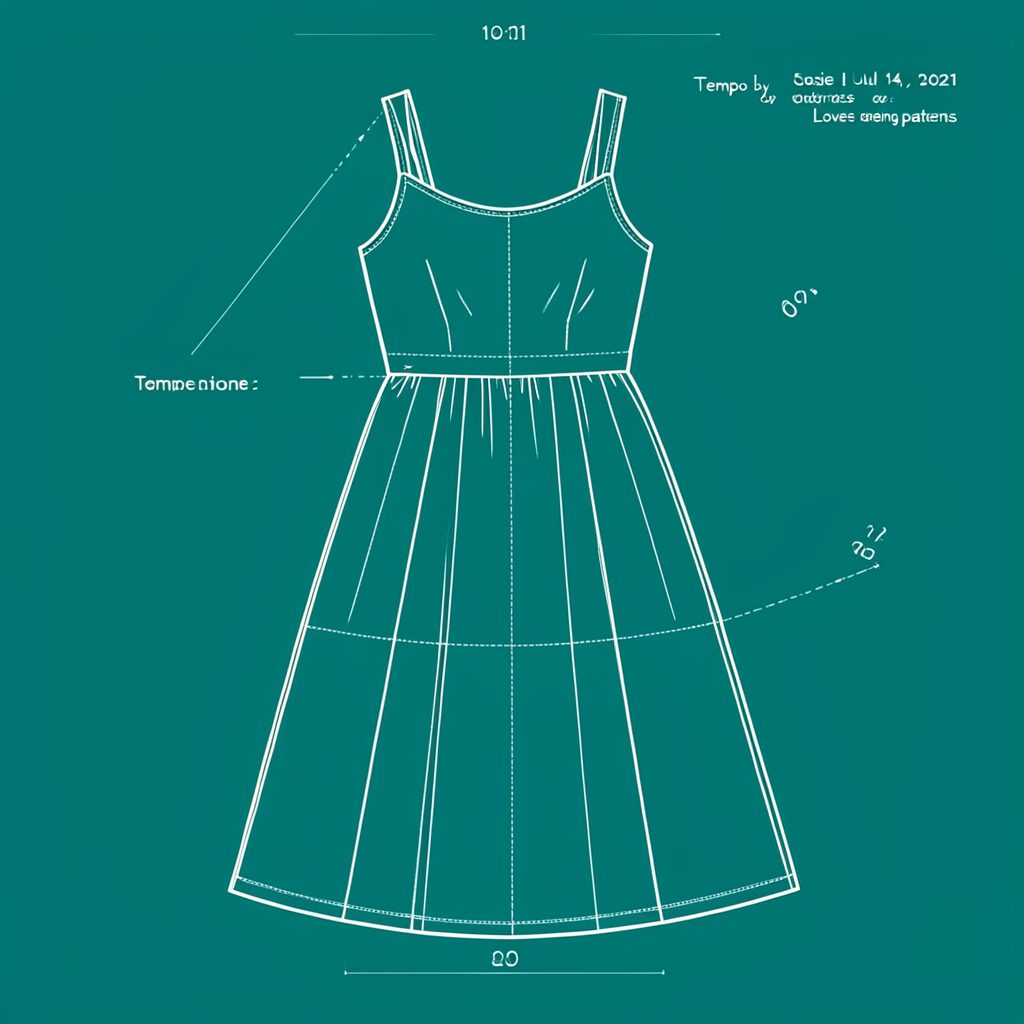
Adding a ruffle hem to the Love Notions Fortuna skirt
A gathered flounce gives the Love Notions Fortuna skirt a fresh lower line while preserving the distinctive work above it. Added to an existing hem, the tier creates movement and gives a familiar indie pattern a new silhouette. It is a manageable way into decorative finishing for sewists comfortable with seams and accurate pressing.
The best result comes from treating the flounce as part of the garment rather than a strip tacked on at the end. Keep the Fortuna’s original hemline, establish the intended length, and decide how much fullness suits the fabric before gathering. A gathered ruffle is the easiest style to add reliably, and the join can be topstitched or enclosed for a softer finish.
Deciding how much flounce to add
A modest 4–6 cm finished ruffle creates a breeze without overwhelming the skirt. A 10–12 cm flounce changes the proportions more dramatically, particularly on shorter or strongly patterned fabric. Measure from the original hem seam to the new edge, then compare that depth with the waistband width and total skirt length.
Fabric weight matters more than fibre name. Cotton lawn makes crisp folds, Tencel or viscose falls in softer waves, and linen can produce irregular gathers. Stable woven cloth is forgiving; very fluid or slippery fabric needs more testing and careful handling.
| Detail | Original Fortuna hem | Gathered ruffle hem | Practical choice |
|---|---|---|---|
| Finished depth | A clean edge with no added volume | Usually 4–8 cm below the original hem | Keep the first version narrow for easier balance |
| Fullness | None | About 25–50% extra fabric at the upper edge | More gathers create softer waves and heavier bulk |
| Fabric response | Depends mainly on the skirt fabric | Light to medium wovens drape well; stiff cloth stands away from the leg | Choose the flounce to complement the skirt |
| Seam | One straightforward hem | An additional join plus a new lower hem | Topstitch or bind the join for a neat finish |
| Difficulty | Beginner-friendly | Confident beginner to intermediate | A ribbon mock-up reduces risk |
Change one variable at a time: depth first, then fullness, then fabric. This makes it easier to identify whether the shape feels wrong because the strip is too short, crowded, or unsupported. Cotton bias binding can conceal exposed seam allowances when the skirt is already lined.
Shaping and gathering the ruffle
A gathered tier can be one long strip, two narrower strips joined with a careful seam, or a purchased pre-gathered frill. A self-cut strip gives control over width and placement, while a commercial frill saves preparation time. For a first alteration, use one piece if the fabric width allows; joins at the back can become bulky after gathering.
To calculate fullness, measure the skirt’s lower edge and call it C. A ruffle with 25–50% extra length needs about 1.25–1.5 times C; 75% fullness needs roughly 1.75 times C. Cut stable fabric on the grain for predictable gathers. Bias-cut strips move more freely, but their stretch changes fullness, so test a small section first.
Hem the ruffle’s lower edge before gathering it. Use long stitches along the upper raw edge, pull the threads in stages, and distribute the folds evenly. Pin the gathered edge to the skirt in sections, match a side seam with one neat pleat, and remove the gathering stitches only when the length and spacing feel right.
Solving the waistband and hem junction
A flounce can hide an uneven hem, but it cannot solve a twisting waistband or uncomfortable rise. Try the skirt on before adding the ruffle and smooth the waist over the body as it will be worn. If the upper edge needs work, Josie’s waistband facing guide explains how to draft a facing that keeps the visible line smooth.
The junction needs a decision. If the skirt is still being made, position and gather the ruffle before completing the final hem. When altering a finished skirt, open the hem enough to expose the seam allowance, align the gathered edge with the original hem line, and enclose the raw edges with the hem allowance or narrow binding. Lining can remain intact if it ends above the new seam.
A visible topstitch gives the variation a crisp, intentional appearance and locks the gathered edge in place. On a lined skirt, check that the lining does not pull near a side opening. Work in short sections, press gently, and keep the topstitch parallel to the hem curve rather than forcing the fabric flat.
Checking fit and movement
Fit the proposed length with ribbon first. Sit, walk, and turn while wearing the skirt, because a flounce that looks balanced while standing can catch underfoot when the hem is short. The original hemline should remain level, and the gathered section should follow it instead of creating a dip at the front or back.
Give special attention to any side slit or vent. The ruffle must not close the opening or catch on the lining during a stride. If the pattern includes one, stop the seam before it, secure the raw edge, and distribute the remaining fullness evenly. A hidden slip can reduce sticking without changing the skirt.
Fullness should look intentional from every angle. Dense gathers can make a small flounce heavy, while sparse gathers may disappear against a smooth skirt. Stand in daylight and compare the ruffle from the front, side, and back. For formal wear, keep the waves controlled; for a weekend skirt, a fuller finish can look relaxed.
Choosing fabrics in the Australian market
Australian sewists have a broad choice of indie patterns, specialty fabrics, and maker blogs such as Coles Corner and Creations. Love Notions PDFs are easy to buy online, but prices may convert into Australian dollars and overseas shipping can change the final cost. Check the size range, printing format, and fabric quantities, then compare the finished measurements with a skirt you own.
Local habits shape fabric choice. Melbourne’s changeable weather calls for layers, Sydney’s humidity favours fluid cloth, and Brisbane’s heat makes lightweight natural fibres comfortable. Many Australian sewists combine new fabric with op-shop finds or share skills through local classes and craft communities, so testing an inexpensive cotton or polyester blend can be sensible before investing in silk.
The Australian Consumer Law matters when an Australian seller provides a faulty or misdescribed digital pattern. Keep the receipt and listing details, contact the designer promptly, and ask for a replacement or remedy under the relevant consumer guarantee. If selling a finished garment, check Australian textile labelling rules for fibre content and country of origin rather than assuming the original fabric label is sufficient.
Practical recommendations for a polished ruffle hem
The most reliable ruffle hem is usually the least complicated: one strip, controlled fullness, and a seam that can be pressed flat. Measure twice, test the proportions with ribbon, and allow time for the lower hem to be finished neatly. Matching the skirt’s topstitch treatment makes the variation feel considered rather than improvised.
For transparency about reviews and commercial relationships, Josie’s site disclaimer explains the policies behind pattern recommendations and blog content. Record the pattern size, fabric quantities, ruffle depth, and finished skirt length in the project notes for future reference.
- Measure the finished lower edge before choosing ruffle width, then compare the depth with the skirt’s waistband for balanced proportions.
- Use 1.25–1.5 times the hem circumference for moderate fullness, increasing only after a ribbon test shows the skirt can move freely.
- Hem the outer edge before gathering, and match one neat pleat to each side seam to reduce bulk.
- Keep the flounce clear of vents and side openings, then walk in the finished skirt to catch any awkward movement.
- Press the seam allowance and flounce before topstitching, using a pressing cloth on delicate viscose or silk.
- Record the pattern size, fabric quantities, ruffle depth, and finished length so another version is easier to make.
Wearing the completed skirt for a full day confirms what a mirror cannot: whether the volume stays comfortable, the hem clears shoes, and the gathered edge keeps its shape after sitting. The Fortuna then retains its recognisable upper construction while gaining a light, playful swing below.
Popular Pattern Reviews
| Pattern | Designer | Type | Highlight |
|---|---|---|---|
| Compose Robe (Kids) | Love Notions | Robe / Loungewear | Sizes 2T–16, cosy & practical |
| Tempo Sundress | Love Notions | Sundress | No closures, shirred back panel |
| Arlington Sweater | Love Notions | Sweater | Cold-weather staple |
| Sybil Illusion Skirt | Love Notions | Skirt (knit) | 7 variations, optional pockets |
| Camden Pinafore | Nina Lee Patterns | Pinafore dress | Year-round layering piece |
| Ogden Cami (dress hack) | True Bias | Cami / Dress | Versatile wardrobe builder |
| Burda 6829 | Burda | Dress | Multi-sized, special-occasion |
Stay in Touch
Subscribe to the newsletter for sewing inspiration, pattern tips, and project ideas delivered straight to your inbox.