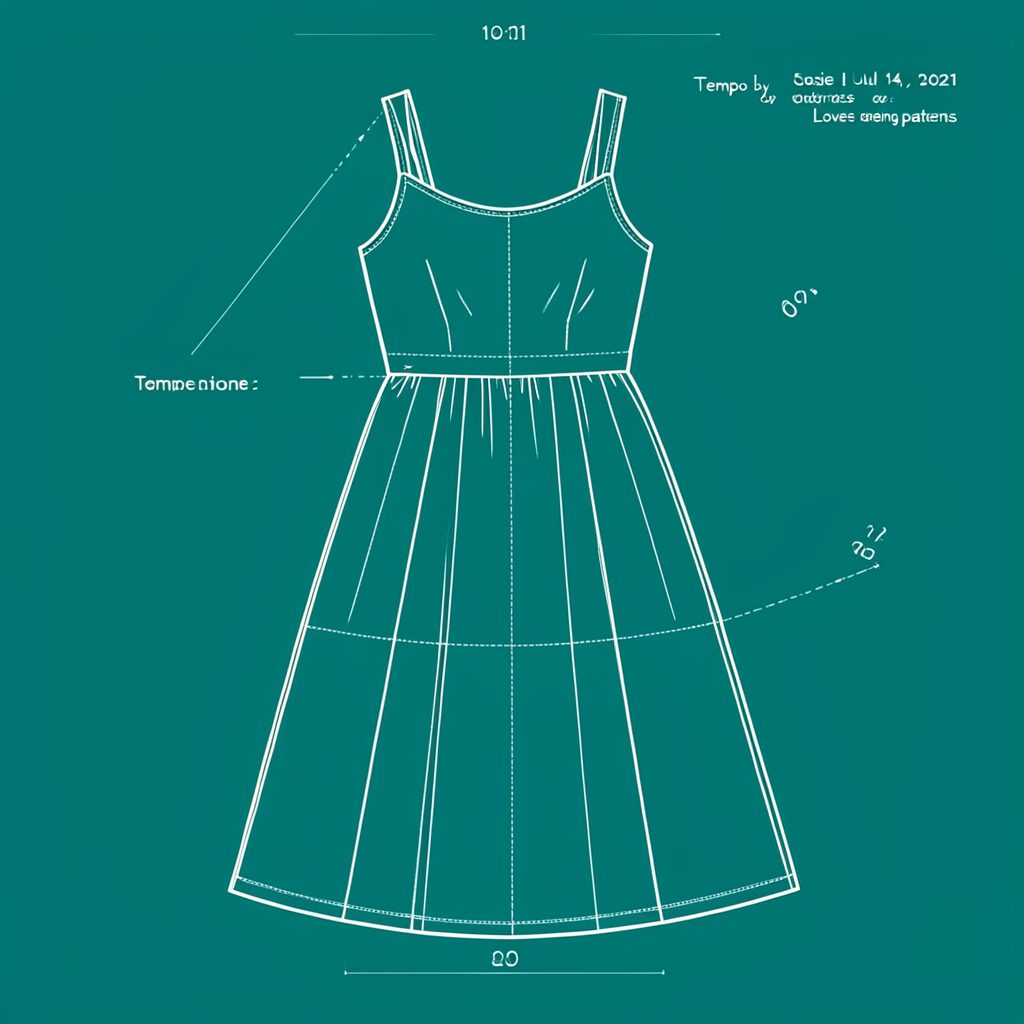
Reviewing the True Bias Lodo Dress
The True Bias Lodo Dress is an elegant indie sewing pattern for sewists who want a polished day dress with movement through the body. Its bias-cut panels shape around curves with less bulk than some straight-grain styles, creating a soft, close-to-the-body line. I assessed the design by checking fit through the bodice, waist and skirt, then comparing its construction with an ordinary gathered or A-line dress.
My verdict is positive for confident beginners and especially satisfying for intermediate sewists. It is not an effortless make: fabric behaviour, cutting accuracy and a proper fitting decide whether the bias flatters or exposes errors. Australian readers also need to compare metric measurements with UK sizing, buy fabric by the metre and plan for seasons opposite to those in Yorkshire.
| Feature | True Bias Lodo Dress | Straight-grain alternative |
|---|---|---|
| Movement | Fluid and curve-hugging | Predictable and structured |
| Cutting | Angled panels demand accuracy | Simpler grain-aligned cutting |
| Fabric | Best in fluid, stable wovens | Works with a wider range |
| Fit | Forgiving over curves, sensitive at upper body | More predictable |
| Skill level | Confident beginner to intermediate | Friendly for beginners |
A dress designed around movement
The Lodo’s strongest feature is controlled fluidity. A seam placed on the true bias can shape a curve without the bulk associated with many conventional dress seams, so the finished dress should move when you walk or sit. The upper body stays neat while the skirt has movement from the waist. That balance gives the design a quietly dramatic quality without relying on stiff interfacing or excessive decoration.
I checked the Fold You So patterns listing against my own measurements before choosing fabric. The size information and illustrations made the intended proportions easy to understand, although I still kept a printed copy of the construction notes beside my machine. Anyone buying digitally should save the pattern in good quality and note the finished garment measurements, as the cut and the bias can make a correct size feel unexpectedly close.
Size and fit close up
True bias makes fitting more forgiving across curves, but it does not rescue a badly chosen size. Compare the finished bust, waist and hip measurements with your own, then add the ease shown in the instructions. Australian consumers should use centimetres rather than assuming a UK medium equals an Australian 10 or 12; sizing varies between labels and body shapes, so the measurement chart is more dependable.
I recommend a quick calico or scrap-fabric toile before cutting the real dress. Fit the bodice first, checking the neckline, shoulder line and upper arm, then assess the waist position and skirt fall. If you are between sizes, the smaller option may suit a closer fit, while the larger one can be appropriate if you want more movement. Make any changes while the garment is still easy to alter, not after the bias seams have been topstitched.
Fabric that earns its name
Lightweight, fluid wovens are the safest choice. Viscose challis, sandwashed cotton, silk-cotton blends and fine Tencel can move with the bias while remaining controllable under the presser foot. Test a double layer before cutting: a fabric that is too soft may grow under tension, while something crisp, heavy or densely woven can make the seams bulky. Stable jersey is not a substitute for a fluid woven unless the pattern explicitly allows it.
Buying locally is part of the pattern planning. Spotlight stores, independent Australian fabric shops and op shops commonly sell by the metre, often in 110-, 140- or 150-centimetre widths, so the cutting layout can change your needs. My sewing pattern library gathers reviews for checking a pattern before committing to cloth. Always compare metreage and fabric width rather than relying on the yardage shown for another shop.
Cutting true bias accurately
True bias is at 45 degrees to the fabric’s straight grain. Mark the grainline and cutting directions before placing the pattern, then keep every bias piece consistent; mixing angles can produce twists and uneven drape. A large cutting mat, rotary cutter, long ruler and sharp scissors make the angled lines easier. Use a sharp blade and unhurried passes, because accuracy matters more than speed.
Fabric handling matters just as much as the cut. Use a walking foot if the machine feeds slippery cloth unpredictably, and pin perpendicular to the direction of stretch rather than pulling the bias between the pins. After prewashing, let the fabric relax and check the marked grainline again. Buying a little extra cloth also reduces the pressure to distort pieces simply to follow an exact metreage figure.
Construction details that count
The Lodo rewards careful organisation more than specialist machinery. Follow the notches, finish seam allowances as directed, and clip curves gradually rather than snipping deep wedges that can show through the finished garment. At the waist, match the seam lines and distribute any easing evenly; pulling one section to fit will create ripples that no amount of pressing will remove. Hem the dress after wearing it for an hour or two, when the skirt has settled into its natural fall.
Fit decisions are often more valuable than tiny construction refinements. If the bodice needs to be shortened, take the measurement from the shoulder seam to the chosen waist position and redraw the outline before cutting. The bodice shortening guide for the Love Notions Verona Sweater demonstrates that method on a different garment, and the same careful measuring-and-redrawing principle applies here.
Styling and community inspiration
The finished dress is versatile enough for a simple arvo walk, a relaxed lunch, a garden party or a summer wedding when the fabric has a little sheen. In Brisbane or Sydney, a lightweight version works for hot afternoons; in Melbourne, a fine wool or viscose blend can handle changeable weather, while a removable layer makes spring and autumn dressing easier. Small handmade earrings, flat leather shoes and narrow belts let the bias silhouette remain the focus.
Seeing the same pattern on different bodies is especially helpful with a close, bias-cut shape. The projects shared by Happy Things Maker show how fabric choice changes the mood of a handmade dress, from softly casual to neatly dressy. This kind of community reference is useful before cutting, because pictures can reveal drape and scale in a way that flat pattern pieces cannot.
Who should make this dress
This is a rewarding project for a sewist who enjoys fitting and fabric decisions. The Lodo does not need to be reserved for expert dressmakers, but a beginner would benefit from a simple first version in inexpensive cloth, careful machine practice and a real fitting. An experienced sewist can exploit the cut with fluid silk, contrast binding or a custom hem. The pattern rewards those adjustments rather than requiring them.
My advice is to treat the sample as a fitting tool, not a display piece. Wear it, sit in it, move around a room and note where the fabric catches or where the waist sits. Then adjust the next version with confidence. For Australian sewists, the useful approach is to source fabric locally where possible, compare measurements in centimetres and allow time for a proper fitting. With those checks in place, the pattern feels ambitious but attainable rather than risky.
Popular Pattern Reviews
| Pattern | Designer | Type | Highlight |
|---|---|---|---|
| Compose Robe (Kids) | Love Notions | Robe / Loungewear | Sizes 2T–16, cosy & practical |
| Tempo Sundress | Love Notions | Sundress | No closures, shirred back panel |
| Arlington Sweater | Love Notions | Sweater | Cold-weather staple |
| Sybil Illusion Skirt | Love Notions | Skirt (knit) | 7 variations, optional pockets |
| Camden Pinafore | Nina Lee Patterns | Pinafore dress | Year-round layering piece |
| Ogden Cami (dress hack) | True Bias | Cami / Dress | Versatile wardrobe builder |
| Burda 6829 | Burda | Dress | Multi-sized, special-occasion |
Stay in Touch
Subscribe to the newsletter for sewing inspiration, pattern tips, and project ideas delivered straight to your inbox.